What is Hydroponics ?
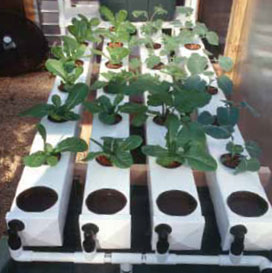 Hydroponics is a subset of hydroculture and is a method of growing plants using mineral nutrient solutions, in water, without soil. Terrestrial plants may be grown with their roots in the mineral nutrient solution only or in an inert medium,
such as perlite, gravel, mineral wool, expanded
clay or coconut husk.
Researchers discovered in the 18th century that plants absorb essential mineral nutrients as inorganic ions in water. In natural conditions, soil acts as a mineral nutrient reservoir but the soil itself is not essential to plant growth.  When the mineral nutrients in the soil dissolve in water, plant roots are able to absorb them. When the required mineral nutrients are introduced into a plant's water supply artificially, soil is no longer required for the plant to thrive. Almost any terrestrial plant will grow with hydroponics. Hydroponics is also a standard technique in biology research and teaching..
Hydroponic growing feeds ultra nutrient rich water directly to the roots of the plant. Feeding nutrients directly to the roots allows the plant to focus less energy on growing a root system and more energy on developing the stems and leaf structures. A nutrient rich powder or solution is added to the water to provide all the nutrients the soil needs.This practice is also more beneficial to the environment. Hydroponic gardening uses less soil and water than traditional gardening.
The first consideration when starting a home hydroponic garden is what you will plant. There are different set-ups and sizes that are optimal for different plants. Choosing wisely in the beginning stages will reduce frustration in the long run.
Hydroponic gardening can be very complicated, with computers and sensors controlling everything from watering cycles to nutrient strength and the amount of light that the plants receive.
On the other hand, hydroponics can also be incredibly simple, a hand watered bucket of sand with a single plant is also a method of hydroponic gardening. Most hobby oriented hydroponics systems are somewhere between the two extremes mentioned above.
The 'average' home hydroponic system usually consists of a few basic parts: 
A growing tray, a reservoir, a simple timer controlled submersible pump to water the plants and an air pump and air stone to oxygenate the nutrient solution. 
Of course, light
(either natural or artificial)
is also required.
The two main types of hydroponics are solution culture and medium culture.
Solution culture does not use a solid medium for the roots, just the nutrient solution.
The three main types of solution cultures are static solution culture,
continuous-flow solution culture and aeroponics. The medium culture method has a solid medium for the roots and is named for the type of medium,
e.g., sand culture, gravel culture, or rockwool culture.

There are two main variations for each medium, sub-irrigation and top irrigation.
For all techniques, most hydroponic reservoirs are now built of plastic, but other materials have been used including concrete, glass, metal, vegetable solids, and wood.
The containers should exclude light to prevent algae growth in the nutrient solution.
Advantages and disadvantages
Advantages
Some of the reasons why hydroponics is being
adapted around the world for food production:

- No soil is needed for hydroponics
- The water stays in the system and can be reused - thus, lower water costs
- It is possible to control the nutrition levels in their entirety - thus, lower nutrition costs
- No nutrition pollution is released into the environment because of the controlled system
- Stable and high yields
- It is easier to harvest
- No pesticide damage
- Pests and diseases are easier to get rid of than in soil because of the container's mobility

Today, Hydroponics is an established branch of agronomy.
Progress has been rapid, and results obtained in various countries have proved it to be thoroughly practical and to have very definite advantages over conventional methods
of horticulture.

There are two chief merits of the soil-less cultivation of plants.
First, hydroponics may potentially produce much higher crop yields.
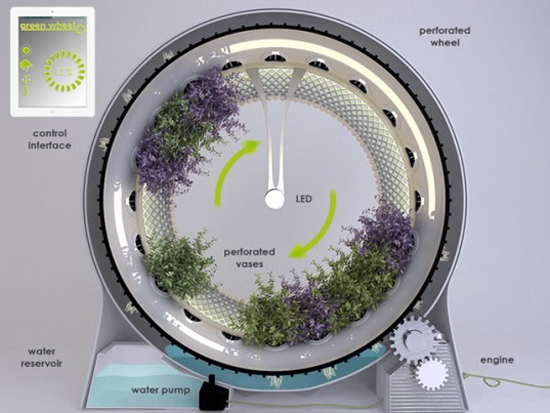
Also, hydroponics can be used in places where in-ground agriculture
or gardening are not possible.
Disadvantages
 Without soil as a buffer, any failure to the hydroponic system leads to rapid plant death.
Other disadvantages include pathogen attacks such as damp-off due to Verticillium wilt caused by the high moisture levels associated with hydroponics and over watering of soil based plants.
Also, many hydroponic plants require different fertilizers and containment systems.
To produce the mineral wool and the fertilizers that are needed to use this method,
a large amount of energy is required.

A number of hydroponic experts are now promoting
hydroponic solutions as cheap ways of producing food in areas with bad soil.

As hydroponic system use less water to grow than traditional farming
it is also a more efficient use of resources.